
What Is Offside in Football? The Rule Explained With Examples
The confusion often comes from one important detail: being ahead of the defenders does not automatically mean a player is offside.
The referee must assess the player's position when a teammate plays or touches the ball and then determine whether that player becomes involved in active play. The position of the ball, the second-last opponent and the attacker's movement all matter.
In this Pitchside254 guide, we explain the offside rule step by step, use practical match situations to illustrate it, examine a real Premier League VAR incident, and explain why a defender's touch does not always reset offside.
What is offside in football?
According to Law 11 of the Laws of the Game, a player is in an offside position when any part of their head, body or feet is in the opponents' half, excluding the halfway line, and nearer to the opponents' goal line than both the ball and the second-last opponent.
However, being in an offside position is not an offence by itself. The player must become involved in active play in one of the ways specified by the rules.
This distinction explains why a forward can stand behind the defensive line without the referee stopping play. If the forward does not interfere with play or an opponent, the position alone is not punishable.
The rule is intended to prevent attackers from gaining an unfair advantage by positioning themselves beyond the defence and becoming involved in the attack from that position.
The three things to check
When judging a possible offside, ask:
Where was the attacker when their teammate played or touched the ball?
Was the attacker nearer to the opponents' goal line than both the ball and the second-last opponent?
Did the attacker subsequently become involved in active play?
These questions provide a useful starting point for understanding most offside decisions.
How to identify an offside position
1. The attacker must be in the opponents' half
A player cannot be in an offside position while in their own half. The halfway line itself is also excluded from the opponents' half for this rule.
For example, a forward may stand close to the halfway line while a teammate controls the ball. If the forward is still in their own half when the teammate plays the pass, they cannot be offside at that moment.
Once the player is in the opponents' half, their position relative to the ball and the second-last opponent becomes important.
2. The attacker must be nearer to the goal line than both reference points
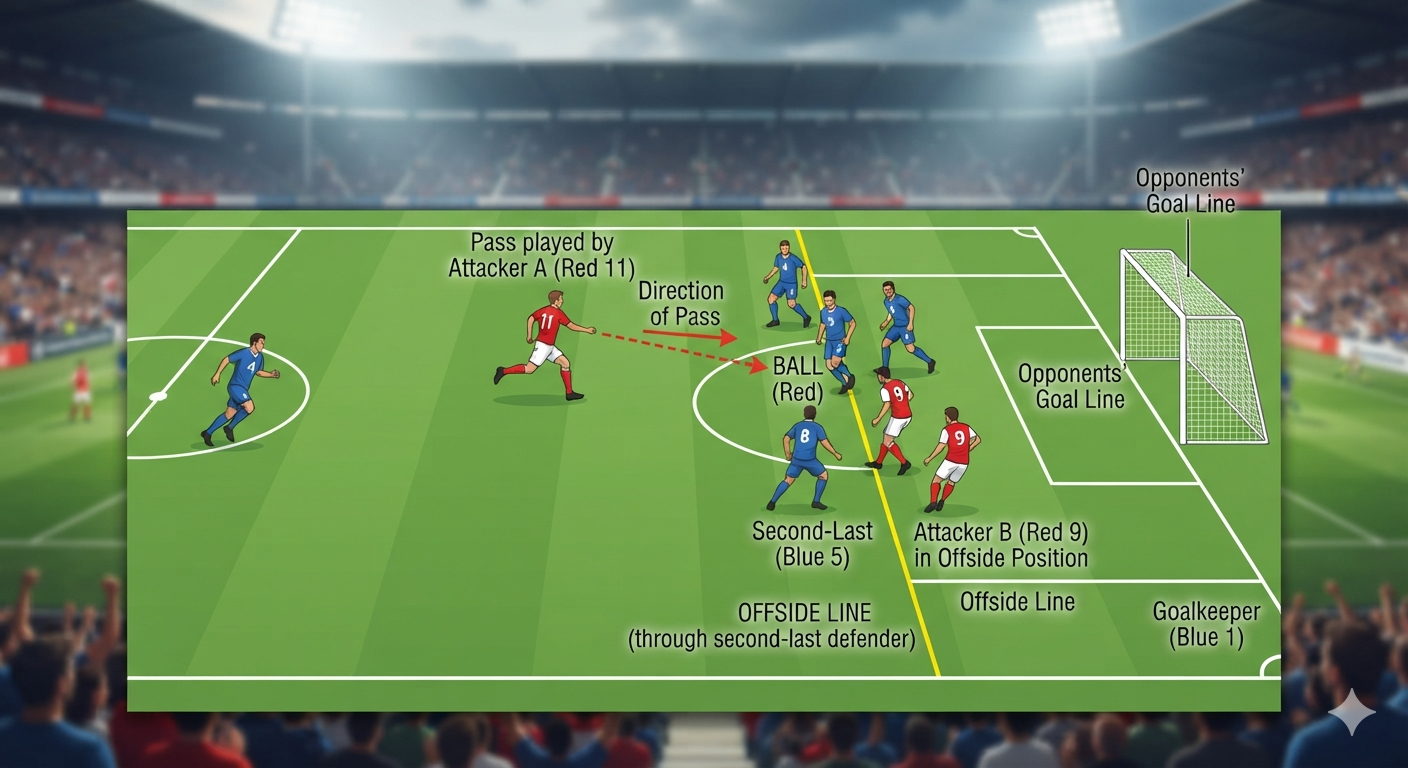
The attacker must be nearer to the opponents' goal line than both the ball and the second-last opponent to be in an offside position.
The second-last opponent is important because the goalkeeper is often the last opponent, but not always. If the goalkeeper comes off their line, another defender may be the last opponent and the goalkeeper may become the second-last.
An attacker who is level with the second-last opponent is not in an offside position. A player who is level with the ball is not in an offside position either.
This is why television replays can be misleading when viewed from an angle that does not clearly show the relative positions of the players.
3. Which body parts count?
Only the head, body and feet are considered when determining offside position. The hands and arms do not count, including those of the goalkeeper.
The upper boundary of the arm is defined by the bottom of the armpit under the Laws of the Game.
As a result, a player may appear level with a defender when looking at their torso, but a legally playable body part could be closer to the goal line. In close decisions, officials need to assess the correct body parts at the correct moment.
Offside explained with a football-pitch diagram
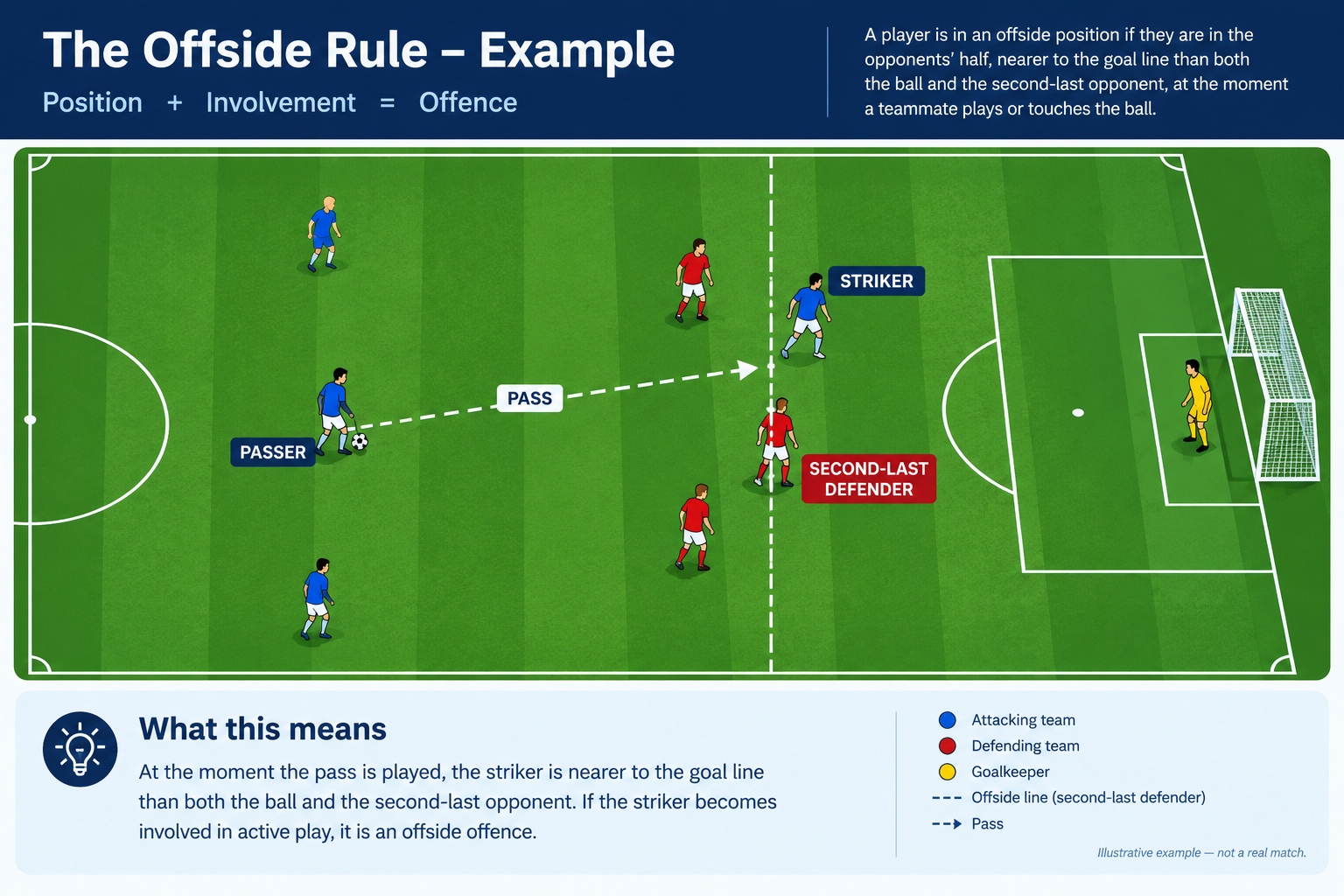
In the diagram, the blue team is attacking towards the goal on the right. The blue player with the ball is the passer, while the advanced blue player is the striker. The red players are defenders.
The dashed line indicates the position of the second-last opponent in this illustrative scenario. When the passer plays the ball, the striker is beyond that reference point and nearer to the goal line than the ball.
If the striker then plays or touches the pass, the referee would penalise the striker for offside, assuming the illustrated positions are accurate and no exception applies.
The important point is that the decision is based on the players' positions when the ball is played or touched by the teammate. The striker's position when the ball eventually arrives does not replace that initial assessment.
When does an offside offence occur?
A player in an offside position is penalised only when they become involved in active play. The Laws of the Game describe three main forms of involvement.
Interfering with play
This is the most straightforward situation. An attacker in an offside position plays or touches a ball passed or touched by a teammate.
Example: A midfielder sends a through ball behind the defence. The striker was in an offside position when the pass was made, runs onto it and controls the ball.
The assistant referee raises the flag and the referee awards an indirect free kick to the defending team.
The striker does not have to score for the offence to occur. Playing or touching the ball is sufficient when the other requirements of the rule are met.
Interfering with an opponent
A player can commit an offside offence without touching the ball if their actions interfere with an opponent in a way covered by the law.
This can include clearly obstructing an opponent's line of vision, challenging an opponent for the ball, or making an obvious action that clearly affects an opponent's ability to play it.
Example: A forward is in an offside position in front of the goalkeeper. A teammate shoots from outside the penalty area, and the forward's position clearly blocks the goalkeeper's view of the ball.
If the referee determines that the forward's position interfered with the goalkeeper in the manner described by Law 11, the goal may be disallowed even though the forward never touches the shot.
Simply standing near the goalkeeper does not automatically constitute an offence. The referee must assess the player's actual impact on the opponent.
Gaining an advantage from an offside position
An attacker may also be penalised if the ball rebounds or is deflected to them from the goalpost, crossbar, match official or an opponent, or after an opponent deliberately saves the ball.
Example: A striker is in an offside position when a teammate shoots. The goalkeeper saves the shot, and the ball rebounds directly to the striker, who scores.
If the striker plays the rebound, the striker has gained an advantage from the offside position and the goal should be disallowed.
This situation is different from a defender deliberately playing the ball in circumstances that reset the offside situation. Understanding that difference is essential.
Five practical offside scenarios
Scenario 1: The striker runs too early
A midfielder looks up and passes the ball forward. The striker has already moved beyond the second-last opponent when the ball is played and then runs onto it.
Decision: Offside, if the striker becomes involved in active play and the relevant conditions are met.
The striker's position is assessed at the moment of the teammate's pass, not when the striker receives the ball.
Scenario 2: The striker times the run correctly
The same midfielder plays a through ball, but this time the striker is level with the second-last opponent when the ball is played. The striker accelerates, receives the pass and scores.
Decision: Onside, provided no other offence occurs.
A player can move beyond the defenders after the pass is played. Being ahead of the defensive line when receiving the ball does not automatically make the player offside.
Scenario 3: The attacker is offside but leaves the ball alone
A winger sends a pass towards an attacker in an offside position. Another teammate, who was onside, reaches the ball and continues the attack.
Decision: Play can continue if the offside-positioned attacker does not touch the ball or interfere with an opponent.
The referee must consider whether the first attacker challenged for the ball, obstructed an opponent or otherwise affected an opponent's ability to play it. If none of these things happened, merely being in an offside position is not an offence.
Scenario 4: A defender deliberately plays the ball
A forward is in an offside position when a teammate passes the ball. A defender has time to see the ball, position themselves and attempt a clearance, but the clearance is inaccurate and reaches the forward.
Decision: The forward may be onside for this phase.
Under Law 11, a defender's deliberate play can mean that an attacker is not considered to have gained an advantage from their earlier offside position. The defender does not necessarily have to execute the pass or clearance successfully.
However, the referee must determine whether the action really was a deliberate play. A hurried, instinctive touch with little control may be judged differently.
Scenario 5: A defender makes an instinctive deflection
A midfielder attempts a through ball towards a striker in an offside position. A defender stretches out a leg at close range and the ball deflects off the defender into the striker's path.
Decision: Offside may still be given.
A deflection does not automatically reset offside. If the striker plays the ball after the deflection, the original offside position may still be relevant.
The distinction between a deliberate play and a deflection depends on the circumstances, including the defender's control, reaction time, the speed and direction of the ball, and the opportunity to play it.
Deliberate play versus a deflection: why the distinction matters
This is one of the most misunderstood parts of the offside rule.
A defender deliberately playing the ball can reset the offside situation. The key question is whether the defender had control of the ball with the possibility of passing it, gaining possession or clearing it.
The IFAB identifies several factors officials can consider, including:
Whether the ball travelled from a distance and was clearly visible.
Whether the ball was moving quickly.
Whether its direction was unexpected.
Whether the defender had time to coordinate their body movement.
Whether the ball was on the ground or in the air.
These factors are considered together. No single factor automatically decides the outcome.
An inaccurate pass or unsuccessful clearance can still count as deliberate play if the defender had control and a genuine opportunity to play the ball.
A deflection is different because the ball may simply strike a defender who has little time or ability to control the action.
There is also an important exception: a deliberate save does not reset offside in the same way. A save is an attempt to stop a ball that is going into, or very close to, the goal.
For the full wording and official examples, consult IFAB Law 11: Offside.
When is there no offside offence?
The Laws of the Game identify three restarts from which a player cannot be penalised for receiving the ball directly:
A goal kick.
A throw-in.
A corner kick.
The word directly is important. The exception applies to the ball received from that restart. If another teammate subsequently plays or touches the ball, the usual offside rules apply to that later action.
Can a player be offside from a corner kick?
A player cannot be penalised for receiving the ball directly from the corner kick. If the ball is then played by another teammate and the player is in an offside position at that later moment, the normal rules can apply.
Can a player be offside from a throw-in?
No, not when receiving the ball directly from the throw-in. The exception does not exempt the player from the offside rule for the remainder of the attack.
Can a player be offside in their own half?
No. A player cannot be in an offside position while in their own half, including on the halfway line.
Does a backward pass automatically cancel offside?
No. The direction of the pass is not the deciding factor. Officials assess the attacker's position relative to the ball and the second-last opponent when the ball is played or touched.
Real match example: Luis Díaz's disallowed goal against Tottenham
A notable example of offside officiating occurred in the Premier League match between Tottenham Hotspur and Liverpool on 30 September 2023.
During the first half, Liverpool winger Luis Díaz ran onto a pass from Mohamed Salah and put the ball into the net. The goal was ruled out for offside, with the match still goalless.
The decision became controversial because the available review showed that Díaz was onside. After the match, the Professional Game Match Officials Limited (PGMOL), the body responsible for professional match officials in England, acknowledged that a significant human error had occurred. It stated that the goal should have been awarded following VAR intervention.
In its subsequent explanation, PGMOL said the VAR process had correctly identified the relevant image and that it showed Díaz was clearly onside. The failure came when the VAR communicated “check complete” without recognising that the on-field decision had disallowed the goal. Play restarted before the error could be corrected under the applicable protocol.
The incident is useful because it demonstrates two separate points:
First, an offside decision depends on accurate assessment of the attacker's position at the relevant moment. Second, VAR depends not only on images and technology but also on officials correctly communicating and applying the review process.
This was not an example of a correct offside decision. It was an acknowledged error, and it should be described as such.
Sources for this case study:
Premier League: PGMOL acknowledge error in Spurs v Liverpool match
Premier League: PGMOL release VAR audio from Spurs v Liverpool
Readers can consult these reports for the official explanation rather than relying only on social-media clips or commentary.
How does VAR check offside?
Video Assistant Referee (VAR) technology can help officials review potential offside offences in competitions where the system is used.
The process generally involves the following steps.
1. Identify the moment the ball was played
Officials establish the relevant moment of contact by the teammate who played or touched the ball. This is important because the attacker's position may change in a fraction of a second.
Under Law 11, the first point of contact when the ball is played or touched is generally used. There is a specific rule for a ball thrown by the goalkeeper, where the last point of contact is used.
2. Assess the attacker's position
Officials use available footage to compare the attacker's relevant body parts with the ball and the second-last opponent.
Depending on the competition's technology, this may involve calibrated offside lines or automated offside tools. Not every competition uses identical systems.
3. Determine whether the attacker became involved
Even if a player was in an offside position, officials must still determine whether an offence occurred. They may need to assess whether the player touched the ball, interfered with an opponent or gained an advantage from a rebound or save.
This is one reason why not every offside decision can be settled simply by drawing a line across the pitch.
4. Communicate the outcome
The VAR team communicates its findings to the referee in accordance with the competition's procedures. Depending on the situation, the referee may receive the decision through the headset or review footage at the pitchside monitor.
VAR procedures and technology can vary by competition, so a review in one league may not look identical to a review in another.
Why can VAR decisions be so close?
Attackers and defenders often move at high speed, and the timing of a pass can be difficult to assess. A small difference in the selected frame can change the relative positions of the players.
Camera angles, the quality of the available footage and the technology used can also affect the review. VAR can provide additional evidence, but it does not make the process immune to human error.
The Díaz incident illustrates why correct communication and careful application of the review process matter just as much as the technology itself.
How teams use the offside rule tactically
Offside shapes both attacking movement and defensive organisation.
The high defensive line
Some teams push their defenders up the pitch to reduce the space available behind them. When the defensive line moves forward together at the right moment, an attacker who has moved too early may be caught offside.
However, the tactic can be risky. If a forward times the run correctly or the passer breaks through the press, the space behind the defence can become a dangerous scoring opportunity.
Timing runs behind the defence
Forwards try to coordinate their movement with the passer. A run that begins too early may lead to an offside flag, while a well-timed run can allow the attacker to move beyond the defensive line after the ball has been played.
This timing is especially important for teams that rely on quick counter-attacks and through balls.
The risk of stepping up
Defenders need to move together if they want to catch attackers offside. A defender who stays deeper may keep the attacker onside, even if the rest of the defensive line has moved forward.
Teams must balance the potential benefit of catching opponents offside against the risk of leaving space behind the defence.
Frequently asked questions about offside
Does a player have to touch the ball to be offside?
No. A player in an offside position can be penalised for interfering with an opponent, such as clearly obstructing their line of vision or affecting their ability to play the ball. However, simply being in an offside position is not an offence.
Is the goalkeeper always the last opponent?
No. The goalkeeper is often the last opponent, but the law refers to the second-last opponent. If the goalkeeper moves forward, an outfield player may be the last opponent or the second-last opponent.
What happens after an offside offence?
The defending team is awarded an indirect free kick from the place where the offence occurred, according to Law 11.
Does a defender's touch always reset offside?
No. A deliberate play by a defender may reset the situation, but a deflection or deliberate save does not have the same effect. Officials assess the nature of the action and the relevant circumstances.
Can a player be offside if the pass goes backwards?
The direction of the pass alone does not determine offside. The attacker's position relative to the ball and the second-last opponent at the relevant moment is what matters.
Does VAR make every offside decision correct?
No. VAR can help officials review footage and correct clear errors, but mistakes can still occur. The review depends on selecting the correct moment, assessing the evidence and applying the rules correctly.
Final thoughts
The offside rule becomes easier to understand when you focus on the moment a teammate plays or touches the ball, the attacker's position relative to the ball and the second-last opponent, and whether the attacker becomes involved in active play.
Being ahead of the defenders is not automatically an offence. A player can move beyond the defensive line after the pass and remain onside, while a player who never touches the ball can still be penalised if they interfere with an opponent.
The distinction between a deliberate play and a deflection is equally important, particularly when a defender attempts to intercept a pass. VAR can help resolve close decisions, but the Díaz incident shows why accurate interpretation and communication remain essential.
The next time an assistant referee raises the flag, look at the position of the attacker when the pass was played. That is usually the best place to begin understanding the decision.
Official references
Premier League — PGMOL acknowledge error in Spurs v Liverpool match
Premier League — PGMOL release VAR audio from Spurs v Liverpool
Editorial note: This guide explains the Laws of the Game as published by IFAB. Check the current official wording and any competition-specific VAR procedures before publication.

Quincy is a seasoned sports journalist, editor, and media professional with extensive experience delivering high-impact content across leading media platforms. Renowned for a discerning editorial perspective and a strong command of the sports industry, Quincy has built a distinguished portfolio spanning sports journalism, strategic storytelling, and content development. With a commitment to journalistic excellence, accuracy, and compelling narrative, Quincy brings a sophisticated editorial app
More from this author →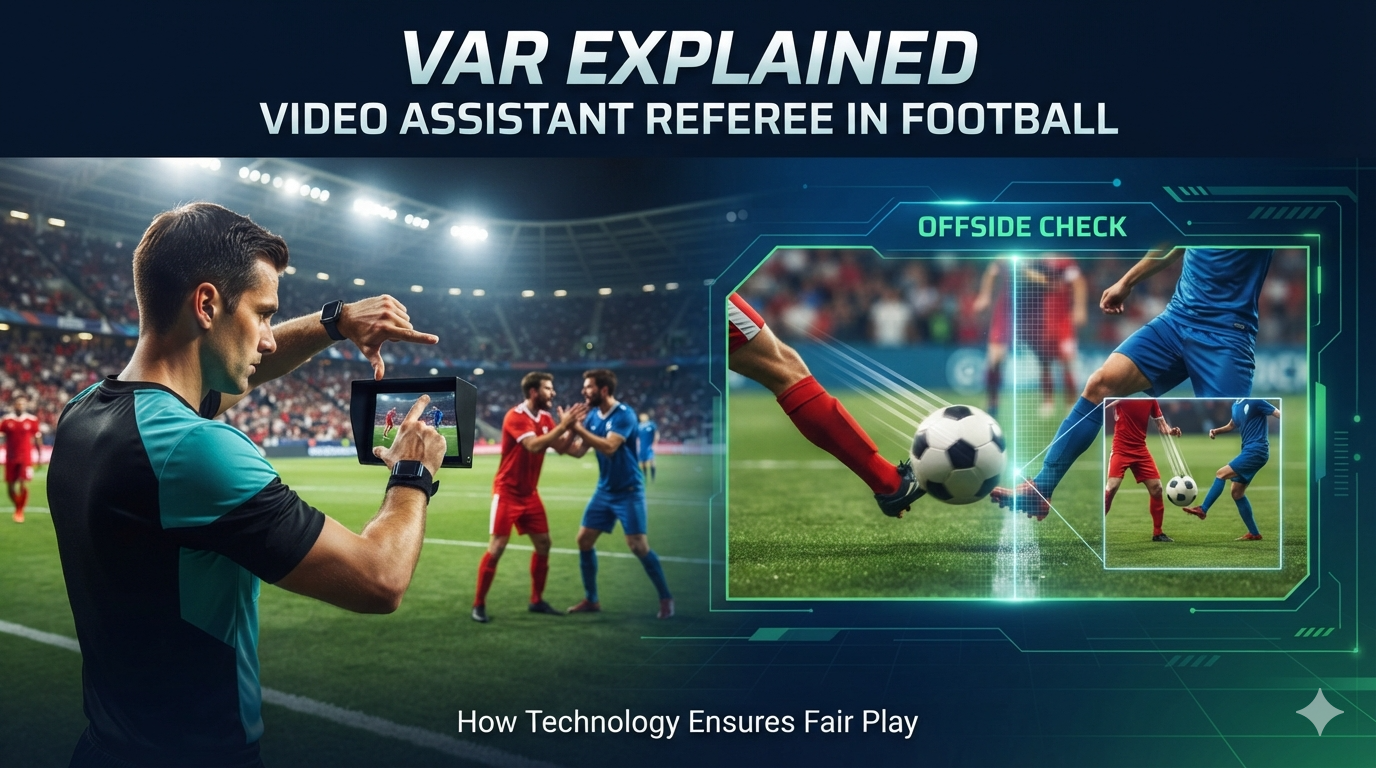
Comments (0)
Be the first to comment on this story.
Leave a comment