What Is VAR in Football? How Video Assistant Referee Works
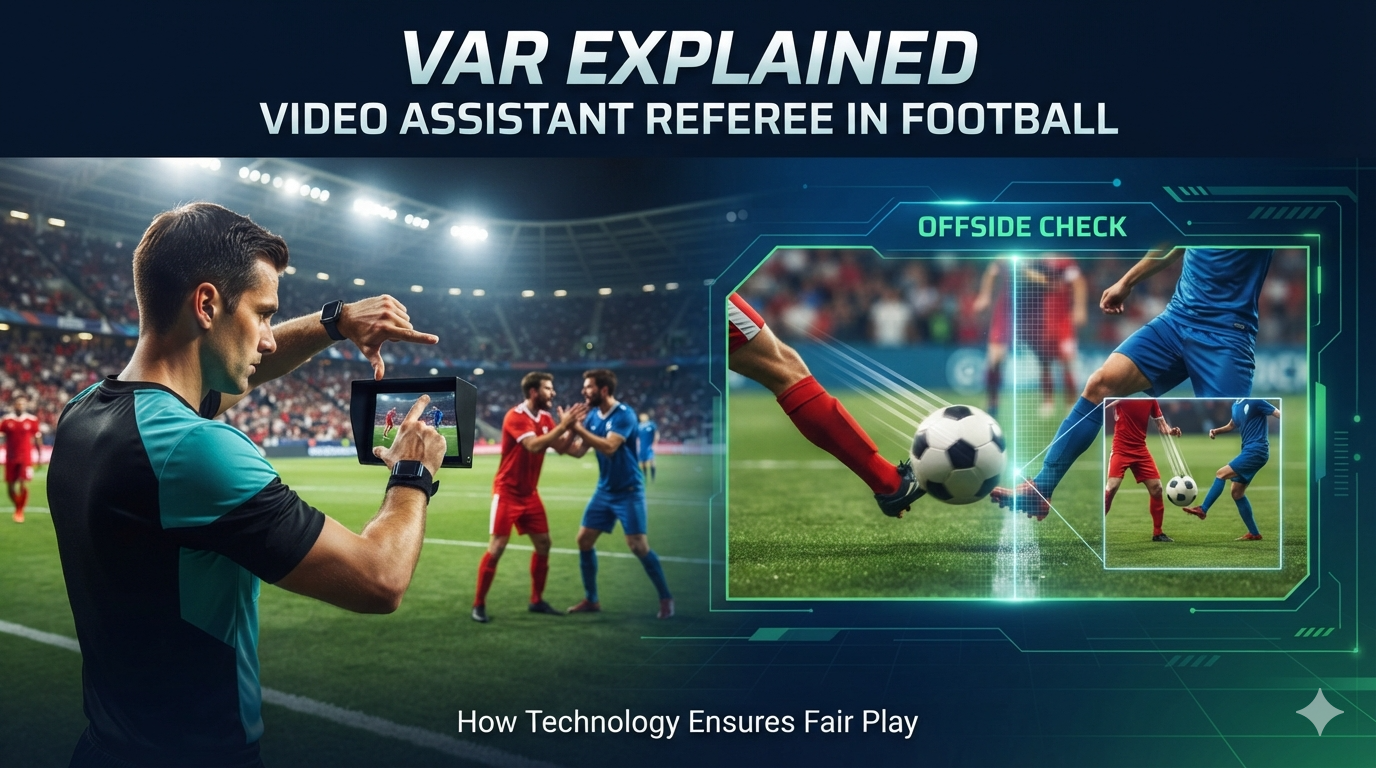
VAR stands for Video Assistant Referee. It is a system that allows match officials to use video replays to help the referee make certain important decisions during a football match.
VAR is designed to reduce major refereeing errors, particularly incidents that could significantly affect the result of a game. It can help officials determine whether a goal should stand, whether a penalty was correctly awarded, or whether a player should receive a red card.
However, VAR does not replace the referee on the pitch. The referee remains responsible for making the final decision, either after receiving information from the VAR team or after personally reviewing footage on a pitchside monitor.
The system is used in competitions authorised to operate it under the relevant football regulations. Its availability and some aspects of its implementation can vary between competitions.
What Does VAR Stand For?
VAR means Video Assistant Referee.
The system involves several officials and technical equipment working together:
Referee: The main match official on the pitch who makes the final decision.
Video Assistant Referee (VAR): A qualified match official who watches video footage and checks incidents that fall within the review rules.
Assistant Video Assistant Referee (AVAR): Assists the VAR by monitoring footage, tracking incidents and helping maintain communication.
Replay operators: Help the video team locate useful camera angles and replay footage.
These officials communicate through a dedicated audio system. The VAR team operates from a video operation room, where it has access to available broadcast camera feeds and replay controls.
How Does VAR Work During a Football Match?
VAR follows a defined process. It is not simply a system that allows officials to replay every foul or controversial moment.
1. The referee makes an initial decision
The referee must officiate the match as normal and make an initial decision. For example, the referee might award a penalty after believing a defender fouled an attacker inside the penalty area.
The referee should not avoid making a decision just because VAR is available.
2. The VAR checks the incident
The VAR automatically checks relevant potential or actual incidents, including goals, penalty decisions, red-card incidents and cases of mistaken identity.
The VAR team examines the available footage from different angles and at appropriate replay speeds.
Most checks do not lead to a formal review. If the video does not indicate a qualifying error or serious missed incident, the original decision generally remains in place.
3. The VAR recommends a review when necessary
If the VAR identifies a potential clear and obvious error or a serious missed incident, the VAR can recommend that the referee review it.
The referee may also initiate a review if the referee suspects a serious incident has been missed.
The VAR cannot independently take over the referee's role and announce a final decision.
4. The referee reviews the footage or receives information
There are two main types of review.
VAR-only review: The referee receives information from the VAR without necessarily watching the footage personally. This is commonly used for factual decisions, such as whether a player was in an offside position or whether a foul occurred inside or outside the penalty area.
On-field review: The referee goes to the pitchside monitor to watch replays. This is generally used for decisions involving judgement, such as the seriousness of a challenge or whether a handball offence occurred.
5. The referee announces the final decision
After the review, the referee communicates the decision and restarts play according to the Laws of the Game.
The original decision may be confirmed, overturned or changed. The important point is that the referee makes the final decision, not the VAR operator.
Which Decisions Can VAR Review?
VAR is restricted to defined categories. It is not intended to review every disputed throw-in, ordinary foul or corner kick.
Under the current IFAB framework, the main reviewable categories are:
1. Goal or no goal
VAR can check whether a goal should be awarded or disallowed.
For example, the video team may discover that:
The attacking team committed a foul during the attacking phase leading to the goal.
The goalscorer was offside.
The ball went out of play before the goal was scored.
A relevant offence occurred during the taking of a penalty kick.
A goal can therefore be disallowed even if the ball clearly crossed the goal line, provided a relevant offence occurred in the phase of play being reviewed.
2. Penalty or no penalty
VAR can check whether a penalty was correctly awarded or whether a clear penalty offence was missed.
Imagine an attacker falls inside the penalty area after contact with a defender. The referee awards a penalty, but the replay shows that the contact occurred outside the box.
The referee may cancel the penalty and award a free kick instead.
VAR can also help identify a clear penalty offence that the on-field officials missed, subject to the review protocol.
3. Red-card incidents
VAR can review qualifying red-card incidents, including serious foul play, violent conduct and offences involving the denial of an obvious goal-scoring opportunity.
Under the current IFAB framework, a clearly incorrect second yellow card that results in a red card can also be reviewable.
However, VAR is not generally used to review an ordinary yellow card simply because a team disagrees with it. The specific rules distinguish between reviewable sending-off incidents and other disciplinary decisions.
4. Mistaken identity
If the referee cautions or sends off the wrong player for an offence, VAR can help identify the correct player.
For example, two players are involved in a confrontation, but the referee shows a red card to the wrong player. Video evidence may allow the referee to correct the identity.
This category is about identifying the player responsible, not reopening every aspect of the incident.
5. Certain incorrectly awarded corner kicks
The current IFAB protocol allows competitions to introduce reviews for clearly incorrect corner-kick decisions, provided the decision can be changed immediately without delaying the restart.
This is a competition option, not a guarantee that every corner decision will be reviewed. If play restarts before the decision can be corrected, it generally cannot be changed through this provision.
The precise implementation depends on the competition's rules and VAR arrangements.
What Does “Clear and Obvious Error” Mean?
One of the most important VAR principles is that the system is not meant to replace every judgement made by the referee.
The original decision should not be changed unless the review identifies a clear and obvious error or a qualifying serious missed incident.
Consider a challenge in midfield. The referee sees the contact and decides that it is a foul but not a red-card offence. The VAR team reviews the footage.
If the replay does not show a qualifying error, the referee's decision generally stands. The fact that another referee might have judged the incident differently does not automatically mean VAR should intervene.
By contrast, if video clearly shows that a player was wrongly identified or that a qualifying incident was missed, intervention may be justified.
This principle is intended to preserve the referee's authority while correcting significant mistakes.
What Is the Difference Between a VAR Check and a VAR Review?
The terms are related, but they do not mean exactly the same thing.
A VAR check is the process of examining an incident to see whether there may have been a clear and obvious error or serious missed incident. Many checks are completed without the referee needing to watch a replay.
A VAR review is the formal process used when an incident requires the referee to reconsider a decision. The referee may receive information from the VAR or inspect the footage personally at the pitchside monitor.
This explains why television viewers sometimes see a goal being checked but do not see the referee walk to the monitor. The check may have confirmed that there was no qualifying error, or the decision may have been factual and suitable for a VAR-only review.
Why Do Referees Sometimes Go to the Pitchside Monitor?
The pitchside monitor allows the referee to watch replays directly before making a final decision.
It is particularly useful when the incident involves interpretation rather than a simple factual question.
For example, video may clearly establish where contact occurred, but the referee may still need to judge whether a challenge was reckless or whether handball was punishable under the Laws of the Game.
In general, factual questions—such as the position of a player or the location of a foul—can often be handled through a VAR-only review. Subjective questions are more likely to require an on-field review.
Going to the monitor does not automatically mean the original decision will be overturned. The referee may watch the footage and still decide that the original call was correct.
Why Does VAR Take So Long?
VAR reviews can take time because officials may need to examine several camera angles, identify the exact moment an incident occurred and determine whether the footage meets the intervention threshold.
Offside decisions can require officials to identify the moment the ball was played and assess the relevant players' positions. Potential penalties may require the team to examine both the contact and the context of the incident.
The referee may also need to review an entire relevant attacking phase before deciding whether a goal or penalty should stand.
The IFAB protocol does not impose a fixed maximum review time. Accuracy is prioritised, although reviews should be completed as efficiently as possible.
Long reviews can frustrate supporters, but speed alone does not determine whether a decision is correct.
Can VAR Make Mistakes?
Yes. VAR can reduce certain types of errors, but it cannot guarantee that every decision will be correct.
The technology depends on the quality and availability of camera footage, the interpretation of the Laws of the Game and communication between officials. Human mistakes can still happen, including mistakes in the review process itself.
Real example: Luis Díaz's disallowed goal against Tottenham
A widely discussed example occurred during Tottenham Hotspur's 2–1 Premier League win over Liverpool on 30 September 2023.
Liverpool forward Luis Díaz scored, but the on-field decision was offside. The VAR team correctly checked the incident, but a communication error meant the on-field offside decision was not overturned. The goal should have been awarded.
The Professional Game Match Officials Limited (PGMOL) later acknowledged a significant human error. Audio released after the match showed how the officials' communication contributed to the incorrect outcome.
The incident demonstrated that even when video technology and the relevant footage are available, the process can fail if officials do not communicate clearly.
For readers who want to examine the case, the Premier League published the official explanation and the VAR audio:
Does VAR Automatically Check Every Foul?
No. VAR does not review every foul, handball or disputed decision.
It automatically checks relevant incidents within its protocol, but it can intervene only when the situation meets the applicable review criteria.
An ordinary free-kick decision in the middle of the pitch will not normally be reviewed simply because players protest or the manager disagrees.
A foul may become relevant to VAR if it forms part of a reviewable incident, such as a goal or penalty decision, or if it concerns a qualifying red-card offence.
This limitation is important because VAR is designed to correct defined, significant errors rather than supervise every action in a football match.
Can a Football Manager Ask for VAR?
Managers and players can communicate their concerns to the referee, but they cannot force the VAR team to review an incident.
The VAR automatically checks the relevant situations. The referee is responsible for initiating a formal review, either following a recommendation from the VAR or because the referee suspects a serious incident has been missed.
Players and team officials must not attempt to interfere with the review process. Excessively making the TV-review signal or entering restricted review areas can lead to disciplinary action.
What Happens When VAR Overturns a Decision?
The referee communicates the revised decision and restarts play according to the Laws of the Game.
The restart depends on what the review establishes.
For example:
If a goal is disallowed for offside, the defending team receives an indirect free kick.
If a penalty is cancelled because the offence occurred outside the penalty area, play may restart with a free kick.
If a wrongly issued red card is overturned, the referee corrects the disciplinary decision as appropriate.
The exact restart depends on the offence and the circumstances. Overturning a decision does not always mean the team that originally appeared to benefit will lose possession.
Is VAR the Same as Goal-Line Technology?
No. VAR and goal-line technology are different systems.
Goal-line technology is designed to determine whether the whole ball has crossed the goal line between the goalposts and beneath the crossbar. It provides a specific answer to a goal-line question.
VAR uses video footage to assist with several categories of decisions, including goals, penalties, red cards and mistaken identity.
A goal can involve both systems in a broader sense, but they perform different jobs. Goal-line technology focuses on whether the ball crossed the line; VAR reviews incidents under the VAR protocol.
Does Every Football League Use VAR?
No. VAR is not used in every football competition.
Its use depends on whether the competition has implemented the system and met the relevant requirements. Some professional leagues and major tournaments use it, while other competitions operate without it because of cost, infrastructure, regulations or implementation choices.
When watching a match, supporters should not assume that VAR is available simply because the game is being played at a professional level.
Frequently Asked Questions About VAR
What does VAR mean in football?
VAR stands for Video Assistant Referee. It is a system in which video match officials help the referee review certain important decisions using replay footage.
Who makes the final decision in VAR?
The referee on the pitch makes the final decision. The VAR can provide information and recommend a review, but it does not replace the referee's authority.
Can VAR overturn a penalty?
Yes. VAR can help correct a penalty decision when the situation meets the review criteria. A penalty may be awarded, cancelled or changed after a review.
Can VAR review a yellow card?
An ordinary yellow-card decision is generally not reviewable on its own. However, the current protocol includes certain specific cases involving a clearly incorrect second caution that results in a red card, as well as mistaken identity.
Why do some VAR decisions not involve the pitchside monitor?
Some decisions are factual and can be resolved through information supplied by the VAR. In those situations, the referee may not need to watch the replay personally.
Does VAR guarantee fair decisions?
No. VAR can help reduce major errors, but footage can be limited, rules sometimes require subjective judgement, and human errors remain possible.
What is the difference between VAR and the referee?
The referee controls the match on the pitch and makes the final decision. The VAR is another match official who uses video footage to assist with specific reviewable incidents.
Final Thoughts
VAR has changed how football officials handle important decisions, giving referees access to video evidence when certain major incidents occur. It can help correct errors involving goals, penalties, red cards and mistaken identity, but it is not designed to eliminate every disagreement.
Understanding the difference between a check and a review—and knowing which incidents VAR can examine—makes controversial decisions easier to follow.
For the official rules, read the IFAB Video Assistant Referee protocol. The protocol is the best reference for the categories of incidents that may be reviewed and the procedures officials must follow.
Editorial note: VAR rules and competition implementations can change. Check the current IFAB protocol and your competition's regulations before publishing updates to this guide.

Quincy is a seasoned sports journalist, editor, and media professional with extensive experience delivering high-impact content across leading media platforms. Renowned for a discerning editorial perspective and a strong command of the sports industry, Quincy has built a distinguished portfolio spanning sports journalism, strategic storytelling, and content development. With a commitment to journalistic excellence, accuracy, and compelling narrative, Quincy brings a sophisticated editorial app
More from this author →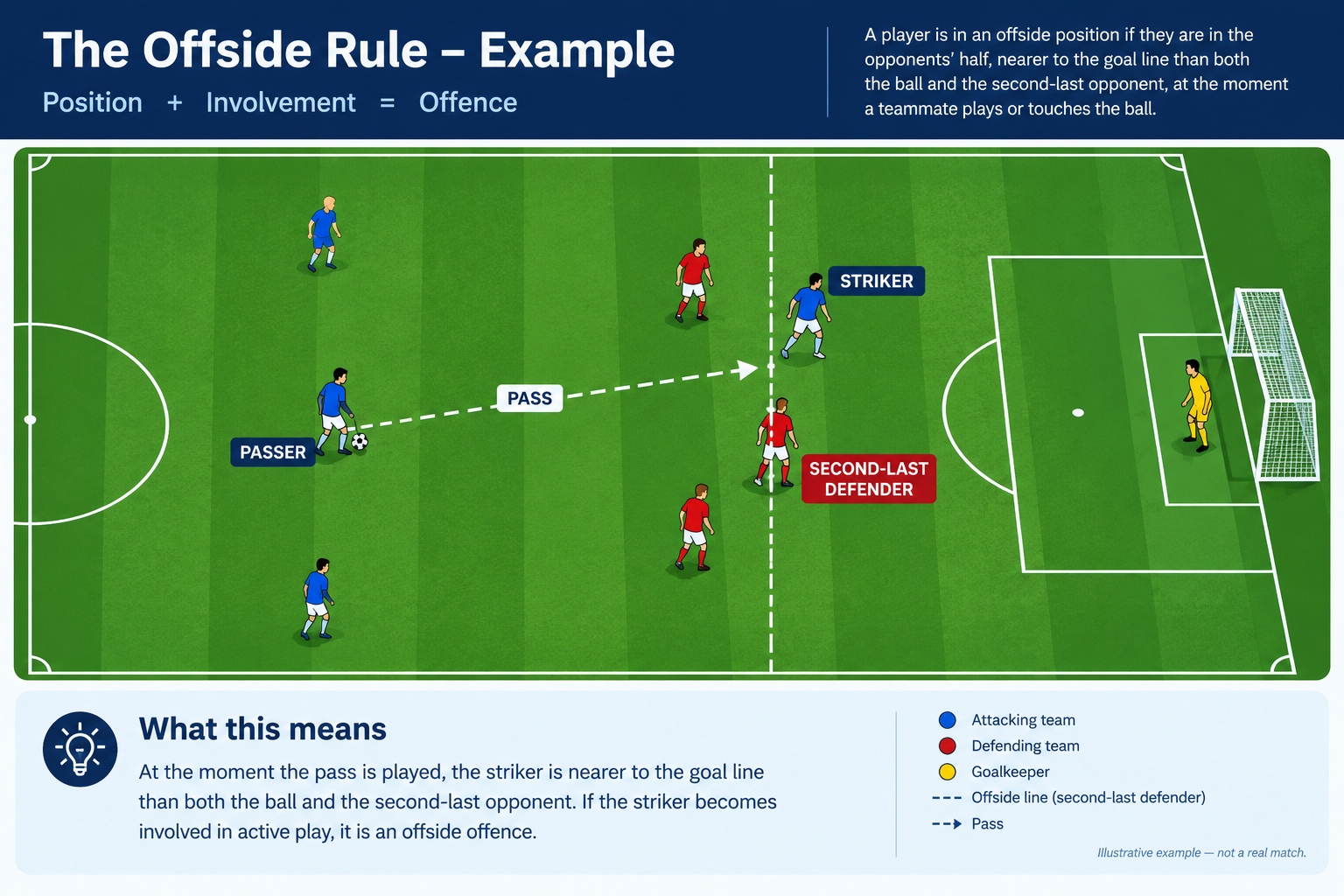
Comments (0)
Be the first to comment on this story.
Leave a comment